
Portillo: My Chilean Range
I had never felt such high anticipation for a mountain before arriving. After my days at Cerro Catedral in Bariloche, I knew South America had surprises in store. Portillo, in Chile, was next. It isn't just a ski resort; it’s a test—a territory of challenges, honest snow, and slopes that demand concentration, courage, and respect.
Anonymous Cooperation | Verified by portillo.ski team
6 min read
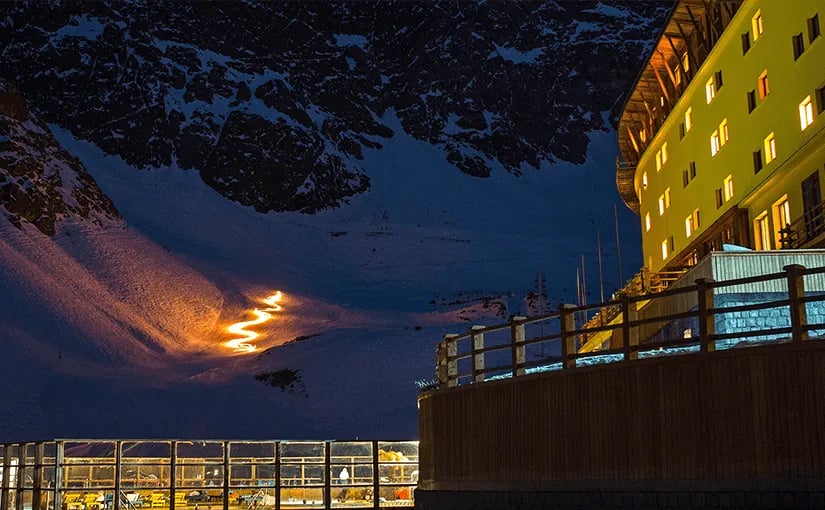
From the moment you take the highway into the Andes, the excitement begins to build. The air turns dry, the range becomes more vertical, and when the yellow hotel finally appears in front of the Laguna del Inca, you know you’ve arrived at a singular place. The snow glitters under the sun, the peaks cut into the sky, and an absolute silence envelops everything. There are no artificial distractions here: this is the real mountain.
For someone with experience, the beginner terrain in Portillo is extremely limited and designed for those stepping onto skis for the very first time. It is a tiny, squeaky space—little more than a learning field for absolute novices. For those of us who have lived on the snow for years, the serious terrain begins higher up. My real adventure started at Escuela 1 and Escuela 2, intermediate runs that serve as the perfect warm-up.
Escuela 1 is generous, allowing you to find your rhythm after the first chair. Escuela 2 kicks up the pitch and forces you to focus on your turns. Here, the snow changes quickly with the sun and wind, and reading it becomes part of the day's technique. I soon realized that Portillo was not a place to "ski to pass the time," but to ski with intention and precision.
Once you pass Escuela 2, you encounter runs that truly reveal the resort's character. Garganta is one of those descents that makes you raise your guard. Narrow and technical, with sections that require decisive edging, Garganta is a blend of pure technique and controlled adrenaline. Here, it’s not about seeking speed; it’s about moving with fluidity, anticipating the terrain, and maintaining rhythm without hesitation.
Higher up, the long runs begin to take shape on the map. Juncalillo is a favorite for those who return year after year. It is an extensive, fluid blue run with a layout that invites you to play with your turns. Its length allows you to find a stable cadence and test different lines as the snow changes. Additionally, its path even crosses part of the international highway—a detail that always brings smiles and comments from those skiing down.
Juncal, for its part, is another generous descent, somewhat wider and with a more constant pitch than Juncalillo. Here, the strategy is not just to ski fast, but to discover your own flow as the day progresses and the snow transforms. When the wind has been gentle, the snow on Juncal offers that firm texture that allows you to carve without fear and feel the edges bite the snow with pleasure.
Another sector I loved exploring early in the morning was Plateau, accompanied by runs like Los Zorros, El Estadio, and Davi’s Run. These descents combine intermediate terrain with subtle technical challenges that force you to constantly read the slope and the snow. They are runs that do not forgive distractions, but they don't intimidate either: they push you to ski with purpose and refined technique.
But if there is one area that defines Portillo's bold character, it is undoubtedly the Roca Jack sector. The Roca Jack lift takes you to serious alpine terrain, with snow that can vary between powder, ice, and hardpack in a matter of seconds. The main run in this sector, also called Roca Jack, is a demanding black diamond with breathtaking panoramic views. You don't ski slowly or without commitment here: every turn demands absolute concentration.
From the top of Roca Jack, when conditions permit, you can access La Travesía—a descent less prominent on the official map but extremely challenging. La Travesía is not for casual skiers; it is steep terrain, often unmarked, where virgin snow awaits—but only if you know what you are doing. For me, La Travesía was one of the most intense lines I’ve ever skied: technical, demanding, and absolutely addictive.
In addition to Roca Jack and La Travesía, there are other intense runs like Cóndor and Plateau Superior, which require rapid shifts in technique and terrain anticipation. Cóndor is especially interesting because it combines wide-open sections with narrower chutes, forcing you to re-read the snow and adjust your turns in milliseconds. At Plateau Superior, on the other hand, you feel the vastness of the Andean landscape; the mountain seems to wrap around you, almost as if you were skiing in a natural amphitheater.
One of the most memorable runs, with a touch of adventure, is the Lake Run. This trail descends fluidly toward the Laguna del Inca, and when the lagoon is solid enough, some brave skiers even dare to cross it on skis. It is a unique experience and something you don't see everywhere in the world: skiing toward a frozen lagoon in the middle of an Andean valley.
All this terrain proves that Portillo is not just a comfortable resort: it is a place that tests you at every turn. And for those of us who want to go beyond the groomed trails, the off-piste is genuinely spectacular. Around sectors like Roca Jack and Plateau, natural faces, couloirs, and untouched terrain open up, revealing themselves only with good snow and a safe context. Exploring off-piste here requires respecting the mountain, managing your decisions, and moving with care, but the rewards are pure lines, untracked snow, and sensations you won't forget.
Between runs, strategic breaks are essential. Going up to Tío Bob’s restaurant during the day is a tradition for those who know this mountain. Tío Bob’s is only open during the day, and its simplicity is part of its charm. Here you can sit, warm your body, have something nutritious, and talk with other skiers about what’s left to do in the afternoon. Eating up there, with a view of the slopes you’ve just conquered and those still waiting, gives a special perspective that no base restaurant can offer.
The gastronomy in Portillo—though not cheap—is designed for bodies that have worked the mountain all day. Hot dishes, well-selected Chilean wine, and a good coffee at the end of the meal feel like a mandatory ritual. It isn't sophisticated haute cuisine, but it is authentic, honest, and deeply satisfying after hours of intense skiing.
And when the mountain calms down and the lifts stop, Portillo doesn't turn off. The night descents with torches are a tradition not seen in many other places. Watching lines of fire descending through the dark snow is almost hypnotic: it’s a moment where the community joins to celebrate the mountain and the light—a mix of adrenaline and ceremony rarely experienced in larger, more commercial resorts.
In the hotel, the bars come to life. These are the moments where you meet the real skiing community: instructors who have descended the same slopes hundreds of times, Olympic skiers training during their off-season, solo travelers with incredible stories, and locals who laugh with the ease of those in no rush. Some opt for outdoor "asados" (barbecues), with meat sizzling and conversations revolving around the best line of the day, the most unpredictable snow, or the perfect turn made on the last run. Others prefer to stay inside with a wine by the fireplace, sharing stories that begin with phrases like, "Do you remember when...?"
The Portillo discotheque, while not massive, has that relaxed vibe that mixes Latin rhythms with international classics. It isn't a luxurious or flashy place, but a space where the energy is genuine and where many friendships are born after hours of shared skiing. Here, no one judges how you dance; they celebrate that you are there.
Portillo is not a giant resort like many found in North America or Europe, but what it offers is pure quality. Every run has a personality: from the technical curves of Garganta to the fluidity of Juncalillo; from the wide descents of Plateau to the adrenaline of Roca Jack and La Travesía; from the Lake Run toward the lagoon to the off-piste faces waiting beside the marked zones.
There are no endless trail counts or massive acreage figures. Instead, there is meaning in every descent, challenge in every curve, and reward in every well-read line. It is skiing where the mountain demands both technique and humility. It teaches you to anticipate, to respect the snow, and to enjoy both the easy and the difficult. Here, you learn to ski the mountain, rather than simply skiing a map.
At the end of each day, when you lie down in your hotel bed—body tired but spirit full—you think about what you’ve lived: the slopes conquered, the descents shared with new friends, the unexpected snow in un-groomed sectors, the nights of wine and fire, the community that laughs, talks, and plans… Portillo doesn't just give you skiing. It offers an experience that stays with you long after you’ve left the mountain behind.
Portillo is not perfect. It doesn't offer absolute convenience or extensive beginner trails. But for those of us seeking challenge, beauty, authenticity, and a mountain that gives you back your dignity with every descent, it is undoubtedly one of the most memorable places on the planet to click into your skis.